Meta’s GEM Update: Your Organic Strategy is Now Your Paid Strategy
Dec 16, 2025

Meta quietely changed the rules again. If your ads aren’t performing the way they used to, you are likely looking for the problem in the wrong place.
Most marketers are obsessing over the technical rollouts of GEM (Generative Ads Model) and Andromeda (Meta’s AI retrieval engine). And while those are the systems driving the change, the implication of those systems is being largely ignored.
Here is the reality of the update: The wall between Paid and Organic has collapsed.
For years, brands have treated organic social and paid media as separate disciplines with separate goals. Under Meta’s new infrastructure, that separation is now a liability.
Here is how the GEM update has turned organic content into the single most important signal for your paid success.
Previously, organic content was about community building or brand awareness. It was "nice to have." Under the GEM model, organic content is raw data.
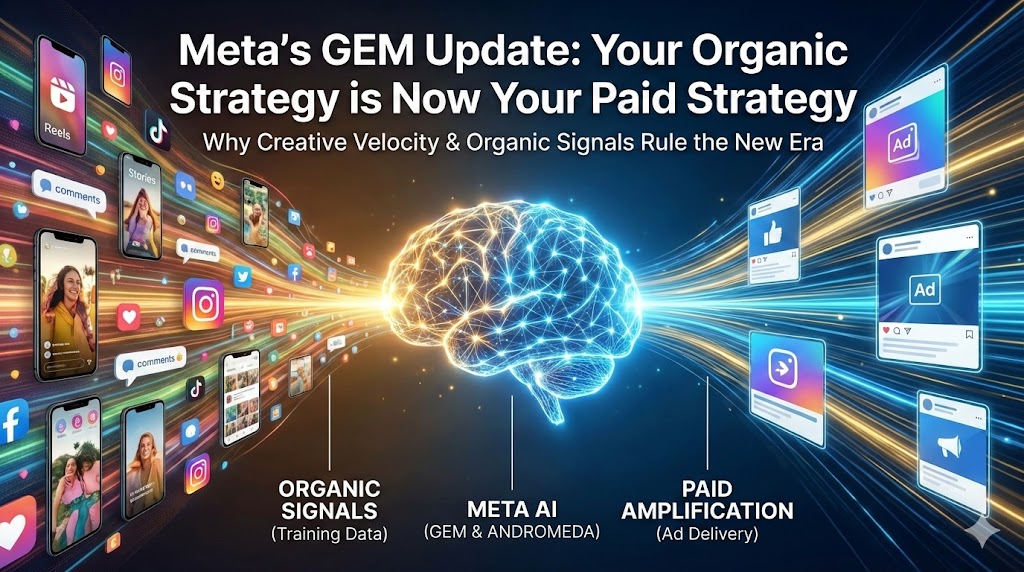
Meta is now openly using organic signals to inform paid ad delivery. The algorithm is no longer looking at your ads in a vacuum; it is looking at your brand's entire footprint across the ecosystem.
When GEM tries to predict which ad will convert a user, it doesn't just look at your ad history. It looks at:
Your organic feed is essentially the "training data" for your paid ads.
If your organic content is flat, inconsistent, or non-existent, you are starving the AI of the context it needs to find your customers. Conversely, strong organic performance acts as a validation signal, teaching Andromeda exactly who cares about your message before you spend a dollar promoting it.
To understand why organic matters so much, you have to understand the engine it is feeding.
GEM is Meta’s predictive engine. Instead of evaluating placements in silos, it looks at the whole picture—Facebook, Instagram, Stories, Reels, and off-platform behavior.
Andromeda changed targeting. It doesn't start with an audience; it starts with the creative and finds the people who match it.
Because the system relies on signals, it needs volume. This is where "Creative Velocity" comes in.
You cannot feed a sophisticated AI model with one "hero" video per month. You need to provide the algorithm with meaningful variety to see what sticks.
If you are still running Paid and Organic in different departments (or different agencies) that don't talk to each other, you are operating on an outdated playbook.
1. Unify Your Content StrategyYour organic posts should reinforce the same stories and value props you run in ads. They are part of the same funnel now.
2. Increase Output via "Lo-Fi" ContentStop over-producing. Use real people, real phone cameras, and real language. Andromeda favors authenticity because it generates better engagement signals.
3. Broaden Your Ad SetsStop micro-managing audiences. Trust that if your organic signals and creative are strong, Andromeda will find the right people. Complex audience stacks only slow down the machine.
4. Feed the System ConstantlyConsistency > Perfection. The algorithm rewards brands that show up every day with fresh signals.
Meta ads are no longer about "hacking" the targeting algorithm. They are about feeding the system high-quality data.
In this new era, your organic content is the most potent data source you have. If you ignore it, your ads fly blind. If you integrate it, you unlock the full power of Meta's AI.
Organic is the signal. Paid is the amplifier.
We’re looking to partner with brands that understand that true growth takes time and a strong foundation. We’ll help you build that foundation, and use it to grow your business. You won’t always love what we have to say, but you’ll love the end results.
Connect with Shoelace 👋

Meta quietely changed the rules again. If your ads aren’t performing the way they used to, you are likely looking for the problem in the wrong place.
Most marketers are obsessing over the technical rollouts of GEM (Generative Ads Model) and Andromeda (Meta’s AI retrieval engine). And while those are the systems driving the change, the implication of those systems is being largely ignored.
Here is the reality of the update: The wall between Paid and Organic has collapsed.
For years, brands have treated organic social and paid media as separate disciplines with separate goals. Under Meta’s new infrastructure, that separation is now a liability.
Here is how the GEM update has turned organic content into the single most important signal for your paid success.
Previously, organic content was about community building or brand awareness. It was "nice to have." Under the GEM model, organic content is raw data.
Meta is now openly using organic signals to inform paid ad delivery. The algorithm is no longer looking at your ads in a vacuum; it is looking at your brand's entire footprint across the ecosystem.
When GEM tries to predict which ad will convert a user, it doesn't just look at your ad history. It looks at:
Your organic feed is essentially the "training data" for your paid ads.
If your organic content is flat, inconsistent, or non-existent, you are starving the AI of the context it needs to find your customers. Conversely, strong organic performance acts as a validation signal, teaching Andromeda exactly who cares about your message before you spend a dollar promoting it.
To understand why organic matters so much, you have to understand the engine it is feeding.
GEM is Meta’s predictive engine. Instead of evaluating placements in silos, it looks at the whole picture—Facebook, Instagram, Stories, Reels, and off-platform behavior.
Andromeda changed targeting. It doesn't start with an audience; it starts with the creative and finds the people who match it.
Because the system relies on signals, it needs volume. This is where "Creative Velocity" comes in.
You cannot feed a sophisticated AI model with one "hero" video per month. You need to provide the algorithm with meaningful variety to see what sticks.
If you are still running Paid and Organic in different departments (or different agencies) that don't talk to each other, you are operating on an outdated playbook.
1. Unify Your Content StrategyYour organic posts should reinforce the same stories and value props you run in ads. They are part of the same funnel now.
2. Increase Output via "Lo-Fi" ContentStop over-producing. Use real people, real phone cameras, and real language. Andromeda favors authenticity because it generates better engagement signals.
3. Broaden Your Ad SetsStop micro-managing audiences. Trust that if your organic signals and creative are strong, Andromeda will find the right people. Complex audience stacks only slow down the machine.
4. Feed the System ConstantlyConsistency > Perfection. The algorithm rewards brands that show up every day with fresh signals.
Meta ads are no longer about "hacking" the targeting algorithm. They are about feeding the system high-quality data.
In this new era, your organic content is the most potent data source you have. If you ignore it, your ads fly blind. If you integrate it, you unlock the full power of Meta's AI.
Organic is the signal. Paid is the amplifier.
.webp)